How Our Solar EPC Services Set New Standards in Reliability & Cost Efficiency
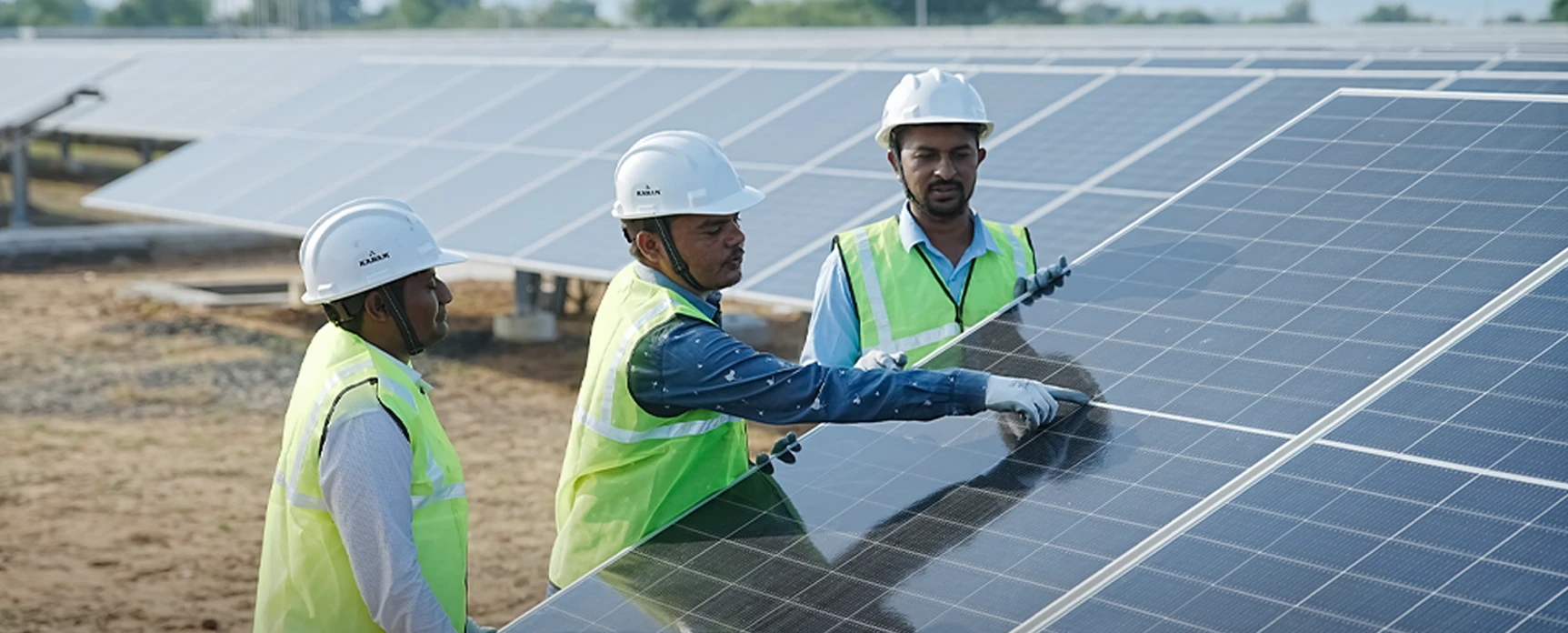
Some factories shift to solar after months of deliberation. Others do it overnight when the electricity bill crosses a threshold no one wants to admit in meetings. However, for every ground-mounted industrial solar plant that is efficient for 25 years, there is an untold story of the project being planned, engineered, installed, tested, and maintained. These stages are always out of the spotlight, but they determine the yield your plant will have every day.
Industrial solar is not complicated because physics is difficult. It is complicated because your facility has moving parts, shifting loads, safety protocols, multiple vendors, and real production pressure. If the energy system is unreliable, the entire plant feels it. That is why the quality of the EPC partner matters as much as the panels you buy.
This blog walks through what goes into dependable solar projects and how we approach them at Green Revolution Powerpark (GRPP), drawing from the ground realities of India’s industrial landscape.
Introduction to Solar EPC Services
When industries explore renewable energy solutions for long-term planning, they often begin with a simple question: “Can solar reduce our operational costs without adding complexity?” Solar EPC brings all the pieces together so the answer becomes clearer. Engineering, procurement, and construction are treated as one responsibility. Instead of juggling multiple contractors, industries work with one team that handles design, technology selection, execution, and testing.
For factories balancing production schedules, safety requirements, and internal approvals, this single-window approach reduces friction. It also ensures that the plant behaves like one integrated system rather than disconnected components assembled under pressure.
Advantages of Solar EPC
A well-executed solar EPC services support industries in three practical ways:
Clarity from day one: The engineering study sets the performance expectations, compliance checks, and integration needs before any purchase happens.
Predictable delivery: One project team is responsible for managing timelines, procurement cycles, permissions, and fieldwork, thereby minimizing delays.
Responsibility for results: The EPC partner, as the owner of design, installation, and testing, is the one to take care of the system’s long-term behavior.
In heavy energy-consuming industries, the situation in which the system’s long-term behavior is the EPC partner’s concern only, hence the downtime can be considered as a strategic advantage, is what makes this accountability a great benefit at the top management level.
Our Approach to Solar EPC Projects
GRPP works in industrial zones where the realities are not theoretical. Ground sites have soil limitations, loads change with production cycles, and local grid conditions differ drastically between states. Our teams build around these constraints rather than assuming ideal conditions.
Our EPC process includes:
Detailed feasibility studies: Every project begins with a realistic assessment of land, shadows, structure capacity, and the site’s electrical ecosystem.
Solar design and engineering tailored for industry: We optimize for CUF and plant predictability, not for brochure numbers. All photovoltaic systems are matched with transformers, cables, protections, and switchgear that suit industrial loads.
Procurement in line with durability: Parts are chosen for their dependability, simple maintenance, and total cost of ownership rather than temporary price reductions.
Implementation that is in harmony with the plant operations: Activities are scheduled considering the working hours, safety regulations, and production areas that are tightly sealed.
Solar project management with practical oversight: Daily coordination, progress tracking, logistics planning, and safety checks are handled by on-ground engineers who understand industrial environments.
This approach keeps projects grounded in the realities of Indian manufacturing.
Reliability: Our Commitment to Quality
Reliability in solar EPC services is not a feature; it is the result of hundreds of small decisions. Cable routing. Foundation depth. Module alignment. Earthing layouts. Testing protocols. These choices rarely show up in proposals, but they define how your plant behaves for decades.
At GRPP, reliability means:
Robust architectural planning for the ground installations to ensure that systems are steady and reliable against wind loads, corrosion areas, and long monsoon cycles.
Installation concentrating on the quality, which is supported by the accuracy of the instruments, the certification of the technicians, and the presence of the supervisor on the spot.
Complete solar panel commissioning with testing of every string, inverter, relay, and protection system before the handover.
Solar maintenance services are built into the project so performance loss is prevented, not reacted to.
Factories that run three shifts cannot tolerate unpredictable output. Reliability is not negotiable, and our work reflects that.
How Our Solar EPC Services Reduce Project Costs
Cost efficiency in industrial solar does not come from cutting corners. It comes from design intelligence and lifecycle thinking.
Industries save money when:
The plant produces consistently for 25 years: Even a small drop in PR or CUF adds up to lakhs in lost generation.
Maintenance needs for the components are kept at a minimum by the selection of components: Low-end components may slightly save money at the beginning, but end up costing much more over time because of replacement and downtime.
The realization of the project does not have an associated rework and delay: Hidden costs are diminished by site readiness, logistics planning, and workforce coordination.
Solar plant optimization is done from day one: Layouts, cable sizing, and inverter loading are planned to reduce transmission losses and improve long-term yields.
With a well-executed EPC project, industries see lower cost per unit of solar energy across the plant’s life, not just in the first year.
Integration of Latest Technology in Solar EPC Projects
Technology adoption in industrial energy cannot follow trends blindly. It must fit the site’s conditions and operational goals.
GRPP integrates:
Advanced monitoring platforms: Real-time insights help facility teams track performance, diagnose issues early, and plan maintenance better.
Hybrid systems with BESS: Battery energy storage is becoming a popular choice for power plants that require stable output, management of peak load, or control of interaction with the grid.
Modern inverters and protection systems: Inverters with advanced grid-support features are one of the factors that make an area with voltage fluctuation more resilient.
Design appropriate for open-access and captive models: In any case, procurement of power through the grid or on-site generation, the technology choices indicate the policy, tariff structures, and compliance requirements.
Technology can only be considered as such when it stabilizes operations and makes planning more convenient. We look at it from that perspective.
Industrial energy decisions not only determine the size of monthly bills. They also determine how industries are going to fit in the picture of state policies, ESG goals, and long-term climate commitments.
Our EPC work contributes to:
Reduced dependence on fossil fuels: Solar energy projects lead to a drastic reduction of Scope 2 emissions in the case of businesses that have a heavy manufacturing component.
Improved land use: We plan for elevated structures so that the maximum amount of space can be utilized.
Long-term green energy initiatives: Considering that India keeps on adding massive industrial loads every year, solar power solutions are a way of lessening the demand for the grid and, at the same time, making it possible for cleaner growth to take place.
Sustainability should not be a statement; rather, it is the result of engineering choices made on a daily basis and done in a responsible manner.
Success Stories in Solar EPC Projects
GRPP has delivered turnkey solar projects across India, built around the specific needs of the facility rather than a standard template.
Ground-Mounted Project for a Large Industrial Unit
Soil conditions and land contours posed challenges. Our team developed a customized foundation plan and optimized the panel layout for local wind patterns. The solar-powered system is still performing efficiently and effectively with little maintenance.
These cases demonstrate that each factory has its own tempo, and solar energy has to adjust to it, instead of imposing itself.
A Closing Reflection
Energy choices define how industries grow, compete, and plan for uncertainty. Solar is no longer about “installing panels.” It is about building systems that stay predictable in real industrial conditions. When engineering, procurement, and construction work in harmony, the plant becomes dependable, costs become manageable, and planning becomes easier for years to come.
At GRPP, we’ve learned that trust is earned on the ground, not in presentations. We are influenced by the environment we create, the industrial plants we work with, and the commitment that comes with sustainable energy solutions.
If this piece of writing is a solar evaluation tool for you, then it has accomplished its purpose.


