Rooftop vs Ground-Mounted Solar for Industries: Which Is Right for Your Factory?

Every factory owner asks the same first question: "Can I just put panels on my roof?"
Sometimes, yes. Often, a roof gives you only a fraction of the power the factory needs. The real choice is not rooftop versus ground-mounted in the abstract. It is what your roof, your land and your load can actually support.
What Is Rooftop Solar?
Panels are installed on the roof of your factory, warehouse or shed. The power is used inside the same premises, with no extra land needed.
What Is Ground-Mounted Solar?
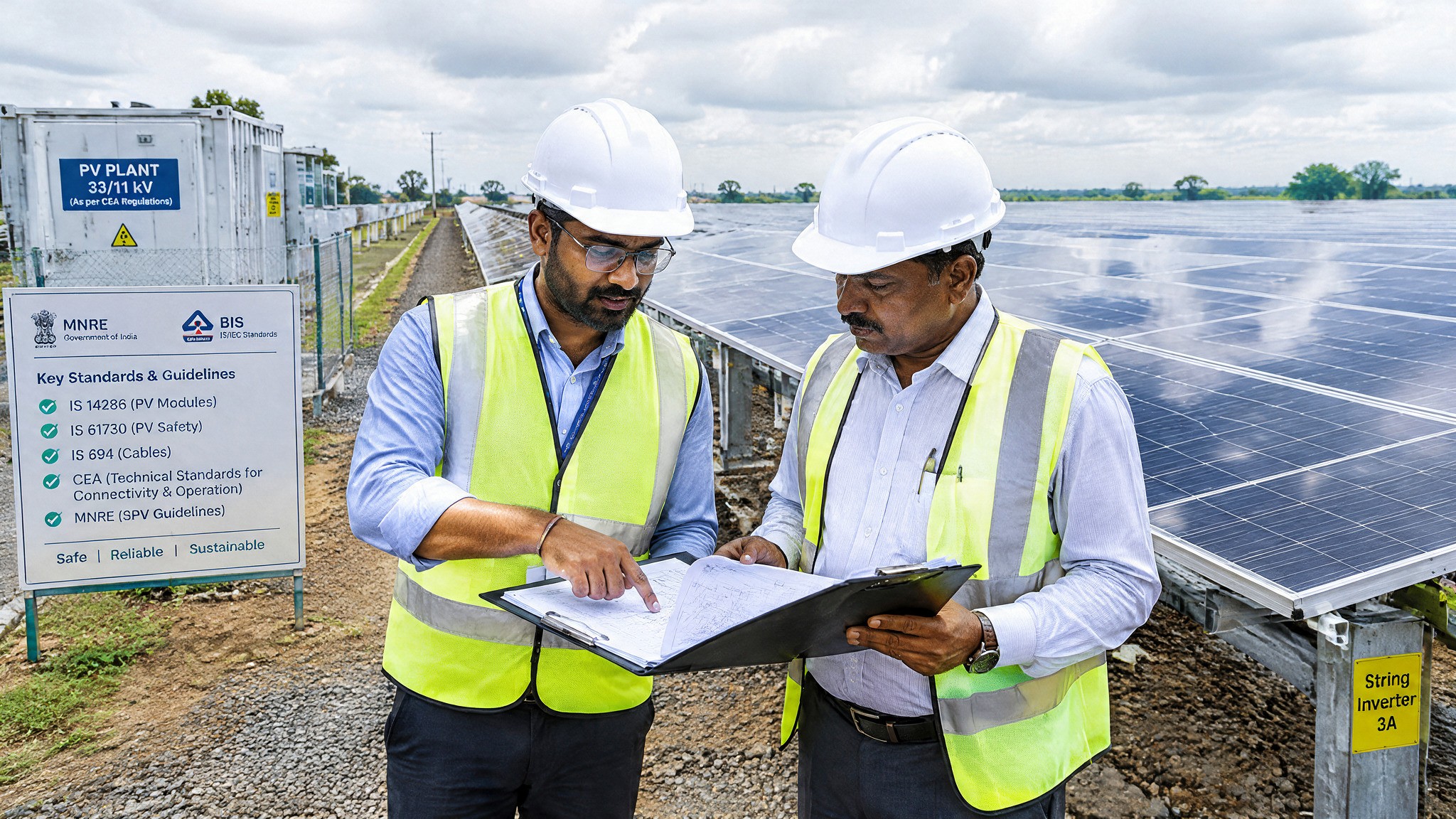
Panels are installed on structures on open land, either inside your premises or on a separate plot. A 2 MW ground-mounted plant needs roughly 8 to 10 acres.
Rooftop vs Ground-Mounted: Key Differences
Capacity: Rooftop — limited by roof area | Ground-mounted — scales to multi-MW
Land: Rooftop — none | Ground-mounted — about 4 to 5 acres per MW
Design freedom: Rooftop — fixed by roof angle and direction | Ground-mounted — optimal tilt and orientation
Installation time: Rooftop — usually shorter | Ground-mounted — longer, with land and civil work
Cleaning and maintenance: Rooftop — roof access needed | Ground-mounted — easier access, simpler layout
Roof impact: Rooftop — load, leakage and warranty questions | Ground-mounted — none
Generation per kW: Rooftop — depends on roof condition | Ground-mounted — typically higher and more predictable
When Rooftop Makes Sense
Land is not available near your unit
Your roof is strong, unshaded and in good condition
Your power requirement is modest compared with roof area
You want a quick, smaller first step
When Ground-Mounted Makes Sense
Your monthly electricity bill is large and the roof cannot cover it
You have land inside or near your premises
You want maximum generation per kW
You plan to expand later
Your roof is old, shaded or structurally weak
Questions to Ask About Your Roof
1. How much usable area is there? Subtract shaded areas, skylights, ducts, exhaust units and safety walkways.
2. Can it carry the load? Panels and structures add weight. A structural check is essential, especially for older sheds.
3. What is the roof material and age? Metal sheet, asbestos and RCC all need different mounting methods. A roof that needs replacement in five years is a poor base for a 25-year plant.
4. Are there leakage risks? Mounting holes in sheets can create leaks if poorly done.
5. Is the orientation workable? Tilt and direction decide generation.
A Quick Sizing Reality Check
A rough rule: 1 MW needs about 4 to 5 acres of land, and rooftop systems need roughly a similar order of area [verify against your layout]. Many factory roofs, even large ones, support only a fraction of a megawatt-scale requirement.
Example: a unit with a ₹50 lakh monthly bill needs several MW of solar to make a serious dent. Most roofs cannot host that.
Can You Combine Both?
Yes. Some factories install rooftop capacity first for quick savings, then add a ground-mounted block as land or approvals come through. This works best when the electrical design plans for expansion from the start.
Cost and Savings View
A ground-mounted plant benefits from scale. Our 2 MW cost guide shows ₹7.5 to ₹9 crore and a typical payback of 3.5 to 5 years in Gujarat. Rooftop costs vary with roof type, structure and strengthening work [verify with project quotes]. Compare them on cost per unit generated over 25 years, not on cost per kW.
Common Mistakes
Sizing the rooftop plant by roof area instead of by load
Skipping the structural check
Ignoring roof replacement plans
Assuming rooftop is always cheaper
Forgetting that shading and soiling hit rooftops harder
Final Thoughts
Rooftop is a good starting point for small loads. Ground-mounted is the answer when the bill is big. Start with your load and your land, and let the numbers choose.
Not Sure Which Fits Your Unit?
Send us your electricity bills and a few roof photos. GRPP will recommend the right plant type.
Green Revolution Powerpark LLP
info@greenrevolutionpowerpark.com
www.greenrevolutionpowerpark.com