3 MW Solar Plant Case Study: How Siyaram Vitrified Reduced Energy Costs
Most factories don’t start their solar journey because they suddenly care about sustainability.
They start when electricity bills begin to behave like an unpredictable business partner.
That was the situation at Siyaram Vitrified Pvt. Ltd. A growing ceramic manufacturer, operating in an energy-intensive industry, where power isn’t just a utility; it’s a core input cost. When your kilns run continuously, even a small fluctuation in tariff or supply hits margins harder than expected.
This is where the conversation around solar shifts. From “green initiative” to “operational control.”
Client Background: Siyaram Vitrified Pvt. Ltd. and Its Energy Challenge
The ceramic industry doesn’t get the luxury of flexible energy usage.
Production cycles are rigid. Equipment runs for long hours. Downtime isn’t just inconvenient; it’s expensive.
For Siyaram Vitrified, the challenges were familiar:
Rising grid tariffs
Dependence on external supply
Limited predictability in long-term energy costs
In industries like this, the real question isn’t whether to adopt solar energy for ceramic industry operations. It’s how soon you want control back.
Project Overview: 3 MW Ground-Mounted Plant at Jamwanthali, Jamnagar
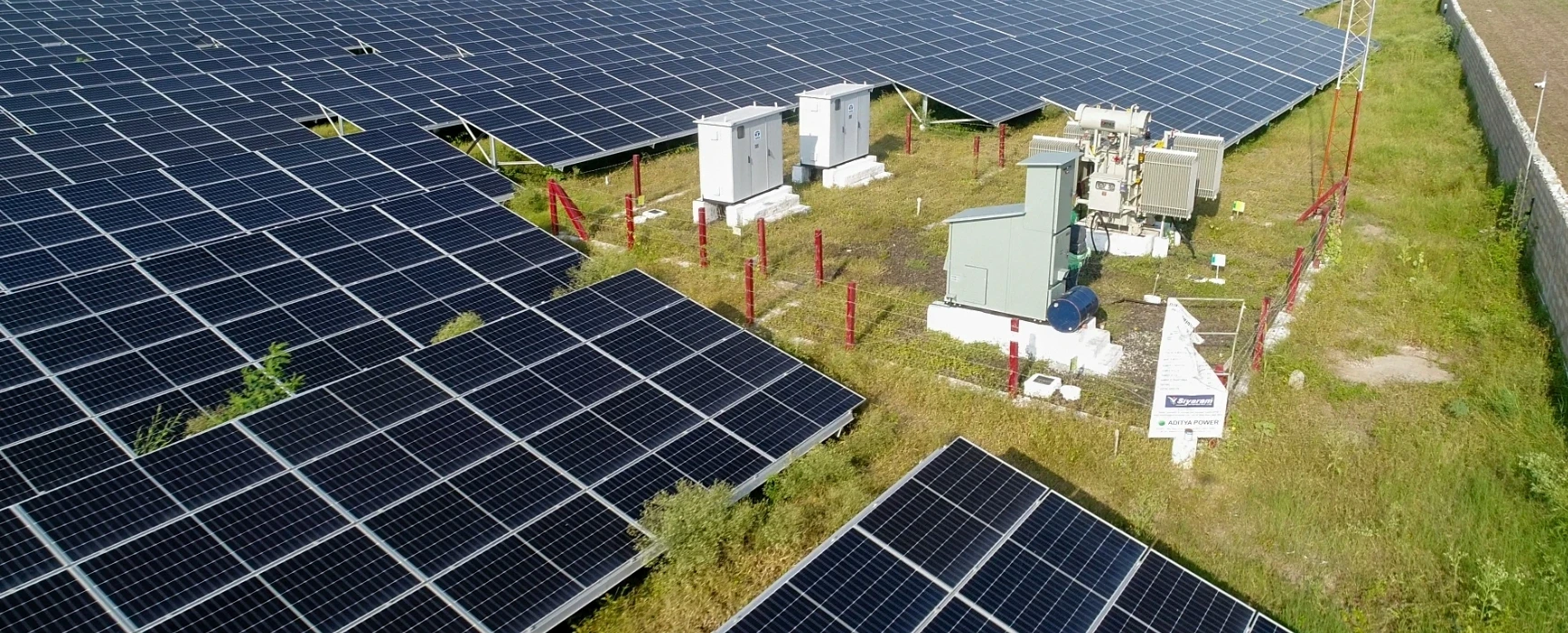
The solution was a 3 MW solar plant Gujarat, installed at Jamwanthali, near Jamnagar.
This wasn’t a rooftop compromise or partial offset. It was a full-scale ground mounted solar power plant, designed to serve industrial demand with consistency.
Key Project Details:
Capacity: 3 MW
Location: Jamwanthali, Jamnagar
Land Area: 38,832 sq. meters
Type: Captive industrial solar power plant
Annual Generation: ~5.1 million units
The idea wasn’t to experiment. It was to build something that works every day, without needing attention every day.
Site Assessment, Land Utilisation & Engineering Design Process
Solar projects don’t fail at installation. They fail at assumptions. The land looks flat on paper. It behaves differently on-site.
At Siyaram, the engineering process focused on:
Soil stability and load-bearing capacity
Layout optimization for maximum generation
Minimizing land wastage without over complicating the structure
In many industrial projects, there’s a silent trade-off between land value and energy output. If not handled well, it leads to inefficient layouts and lower generation per acre.
The goal here was simple: Every square meter should justify its existence.
This is where an experienced solar EPC company in Gujarat matters, not just for execution, but for decisions that happen before execution.
How GRPP Delivered Turnkey Execution on 38,832 sq.m.
A solar project isn’t one activity. It’s a sequence where delays in one stage quietly affect everything else.
GRPP approached this as a full turnkey solar solutions in Gujarat project, covering:
Detailed engineering
Procurement of modules, inverters, and structure
On-ground installation
Testing and commissioning
What often gets ignored in conversations is logistics.
Early projects like Siyaram didn’t come with perfect site conditions. Teams worked with limited infrastructure, basic facilities, and long on-site hours. Engineers and workers adapted in real time, learning from the ground instead of waiting for ideal conditions.
That’s the difference between planning a project and delivering one.
Annual Generation: 5.1 Million Units and What That Means for Your Energy Bill
Numbers only matter when they connect to business impact. This plant generates approximately 5.1 million units annually.
For an industrial unit, this translates into:
Significant reduction in grid dependency
Lower cost per unit over time
Better predictability in energy expenses
Instead of reacting to tariff changes, the business starts operating with a known baseline.
That’s the quiet advantage of a well-executed solar power plant for industry. It doesn’t just save money; it stabilizes decisions.
ROI, Payback Period & Long-Term Savings - The Numbers That Matter
Industrial decision-makers don’t need inspiration. They need clarity.
While exact numbers vary based on tariff structures and usage, a typical solar ROI Gujarat scenario for projects like this includes:
Payback period: ~3 to 5 years
Plant life: 25+ years
Long-term savings: Substantial reduction in energy costs after payback
After payback, your energy cost doesn’t go to zero. It becomes predictable and controlled.
That’s far more valuable than temporary savings.
Environmental Impact: 4,335 Metric Tons of CO₂ Reduced Annually
Industrial sustainability often sounds abstract until you put numbers next to it.
This project reduces approximately:
4,335 metric tons of CO₂ annually
That’s not just compliance or reporting.
For companies exporting globally, this directly supports:
ESG goals
Buyer expectations
Long-term brand positioning
In many cases, renewable energy for industrial operations becomes a competitive advantage, not just an operational decision.
Operations & Maintenance: Keeping the Plant Performing Post-Commissioning
Most solar discussions end at installation. Reality starts after that.
A plant doesn’t perform for 25 years just because it was installed well. It performs because it is maintained well.
The solar plant operations and maintenance approach here focuses on:
Continuous monitoring of performance
Preventive maintenance
Quick resolution of on-ground issues
There’s a real example behind this mindset.
At another project site with difficult land conditions, the Green Revolution Power Park O&M team stayed on-site for nearly two weeks straight to stabilize performance issues, including equipment failure and structural challenges. The plant was brought back online within 20 days.
That kind of ownership doesn’t show up in brochures. It shows up when something goes wrong.
Industrial Solar Plant Case Study Gujarat: What This Project Really Teaches
This isn’t just an industrial solar plant case study Gujarat. It highlights a few uncomfortable but important truths:
Solar is not plug-and-play.
Every site behaves differently.
Land decisions affect generation more than most people expect.
Execution quality is invisible when things go right, but very visible when things go wrong
O&M is not a support function. It is the difference between average and optimal performance
When industries evaluate a top solar EPC company in Gujarat, these are the factors that actually matter.
Not just capacity installed. But how that capacity performs over time.
Is Your Factory Ready for Ground Mounted Solar Power Plant?
Not every factory should rush into solar. But every factory should evaluate it with the right people in the room.
Look at your current situation closely:
Are rising energy costs starting to affect margins or pricing decisions?
Is your team struggling with unpredictable power expenses month after month?
Does your site have land that could be used more efficiently?
If these questions are already coming up internally, then exploring a setup like a solar power plant Jamnagar Gujarat, is no longer a distant idea. It’s already part of your decision-making.
At that point, the role of a solar EPC company in Gujarat is not just execution.
It’s clarity:
What works for your site
What doesn’t
And what mistakes are expensive enough to avoid early
A Final Thought
Solar doesn’t transform a business overnight.
It quietly removes one of the biggest uncertainties from it.
For companies like Siyaram Vitrified, that shift isn’t about technology. It’s about control, stability, and thinking long-term in a space where most decisions are still reactive.
And if you’ve been in manufacturing long enough, you already know how rare that is.


